


Personal Finance Tips: A Complete Guide for Beginners
Managing money can feel complicated, especially when bills keep arriving, unexpected expenses appear, and there always seems to be something else worth buying. The good news is that personal finance does not have to involve complicated spreadsheets, advanced investing strategies, or a huge salary. In many cases, improving your finances starts with a few practical habits that you can actually maintain.
Personal finance is really about making intentional decisions with the money you earn. That includes knowing where your money goes, controlling unnecessary spending, preparing for emergencies, managing debt, saving consistently, and planning for long-term goals. You do not need to become perfect with money overnight. Small improvements, repeated consistently, can make a surprisingly large difference over time.
The most useful personal finance tips are usually the ones that fit naturally into everyday life. A budget that is too restrictive may work for a week and then become impossible to follow. A realistic plan, however, can help you spend on things you enjoy while still making progress toward financial security. The goal is not to stop enjoying your money; it is to make sure your money supports the life you actually want.
Start by Understanding Where Your Money Goes
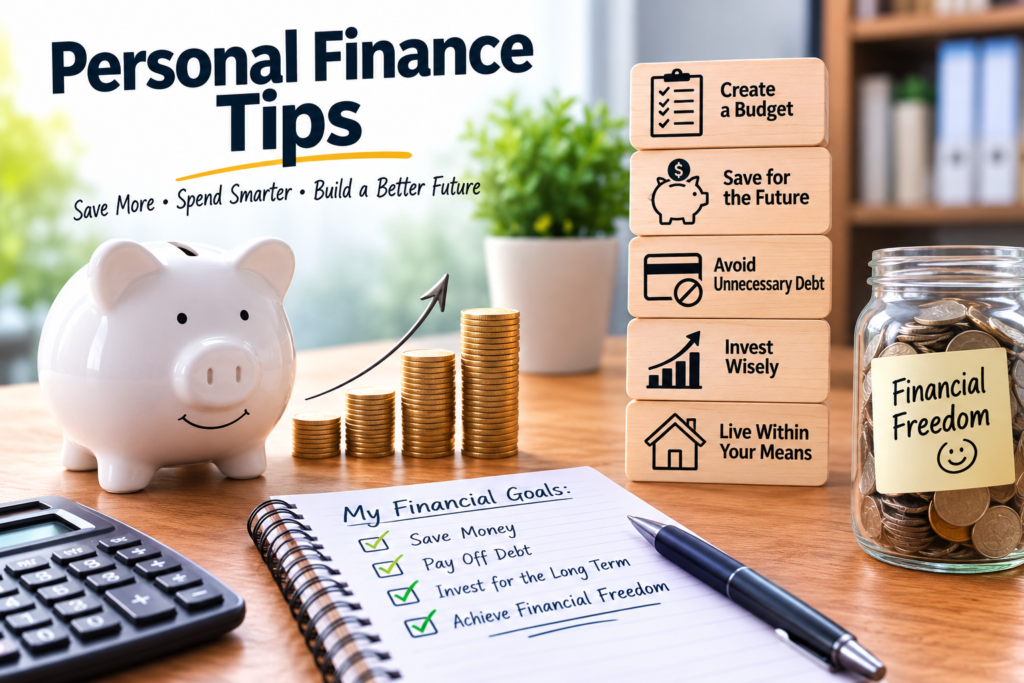
One of the most important personal finance tips is also one of the simplest: know what you are spending. Many people have a general idea of their income and major bills but do not pay attention to smaller purchases. A coffee here, an online order there, and several subscriptions can quietly consume a meaningful portion of a monthly budget.
For at least one month, track your spending without judging yourself. Record rent or mortgage payments, utilities, groceries, transportation, entertainment, subscriptions, shopping, dining out, and other expenses. Looking at the complete picture can reveal patterns that are difficult to notice when you only check your bank balance occasionally.
Once you understand your spending habits, you can decide what needs to change. You might discover that you are spending more on convenience than expected, or perhaps several subscriptions are rarely used. The point of tracking is not to make you feel guilty. It is to give you information so you can make better decisions with your money.
Create a Realistic Budget
A budget gives every part of your income a purpose. Instead of simply spending money until the next payday, you decide in advance how much should go toward essential expenses, Personal Finance Tips savings, debt payments, and flexible spending. A good budget should feel like a useful guide rather than a punishment.
Start with your monthly take-home income and list your essential expenses. These usually include housing, utilities, food, transportation, insurance, minimum debt payments, and other necessary costs. Then consider financial priorities such as emergency savings, retirement contributions, or another important goal. Whatever remains can be allocated to flexible spending.
Do not make your first budget unrealistically strict. If you normally spend some money on restaurants, hobbies, entertainment, or shopping, include a reasonable amount for those categories. A budget that allows some enjoyment is often easier to maintain than one that eliminates every nonessential purchase.
Build an Emergency Fund
Unexpected expenses are one of the biggest reasons people fall into financial difficulty.Personal Finance Tips A car repair, broken appliance, temporary loss of income, or urgent family expense can be stressful enough without having to borrow money to cover it. An emergency fund provides a financial cushion for situations you did not plan for.
You do not have to build a large emergency fund immediately. Start with a small target that feels achievable, then increase it gradually. Even a modest cash reserve can be useful because it gives you an alternative to immediately reaching for a credit card or loan when something goes wrong.
As your financial situation improves, work toward having several months of essential expenses saved. The right amount depends on factors such as income stability, household responsibilities, employment situation, and monthly costs. Keep emergency savings somewhere accessible and relatively safe rather than putting money needed for emergencies into highly volatile investments.
Make Saving Automatic
Saving becomes much easier when you do not have to rely on motivation every month. One effective personal finance habit is to automate your savings. Set up an automatic transfer shortly after receiving your income so that a predetermined amount moves into your savings account before you have an opportunity to spend it.
Personal Finance Tips The amount does not have to be enormous. Saving a small percentage consistently can be more sustainable than attempting to save a large amount for a few months and then giving up. As your income increases, consider increasing the automatic transfer as well.
Automation also creates separation between spending money and savings. When money intended for a financial goal is kept in a separate account, you are less likely to accidentally treat it as available spending money. Over time, the habit becomes normal, and saving requires less conscious effort.
Control High-Interest Debt
Debt is not automatically bad, but expensive debt can make it much harder to build wealth.Personal Finance Tips High-interest credit card balances are particularly challenging because interest can accumulate quickly when balances are carried from month to month. If you are paying substantial interest, reducing that debt can become one of your strongest financial priorities.
Begin by listing your debts, including the balance, interest rate, and minimum payment for each one. This gives you a clear picture of what you owe rather than allowing debt to remain an abstract source of stress. Continue making required minimum payments while directing additional money toward the debt strategy you choose.
Two common approaches are the debt avalanche and debt snowball methods. The avalanche method focuses extra payments on the debt with the highest interest rate, potentially reducing total interest costs.Personal Finance Tips The snowball method focuses on the smallest balance first, which can provide quick psychological wins. The best approach is the one you can consistently follow.
Be Careful With Lifestyle Inflation
Personal Finance Tips Earning more money is exciting, but a higher income does not automatically create financial security. Lifestyle inflation occurs when spending increases as income rises. Someone may receive a raise and immediately upgrade their car, move into a more expensive home, eat out more often, and increase discretionary purchases until the additional income disappears.
There is nothing wrong with enjoying a higher income. The problem occurs when every increase in earnings becomes an increase in expenses. If you receive a raise, consider automatically directing part of the additional money toward savings, investments, or debt repayment before adjusting your lifestyle.
This approach allows you to enjoy progress while still improving your financial position. You might upgrade certain areas of your life while keeping other expenses stable. Over several years, the difference between increasing spending by the full amount of every raise and saving a portion can become substantial.
Separate Needs From Wants
One of the most useful personal finance tips is learning to distinguish between needs and wants. Needs are expenses required for basic living and responsibilities, while wants are purchases that improve comfort, convenience, entertainment, or enjoyment. The distinction is not about labeling wants as bad; it is about understanding priorities.
Before making a purchase, ask yourself whether you genuinely need it, whether you can comfortably afford it, and whether it supports your current financial goals. For larger purchases, consider waiting a day or two before buying. A short pause can reduce impulse spending and give you time to decide whether the purchase is genuinely worthwhile.
You can also create a specific category for fun spending. This removes the feeling that every enjoyable purchase is a financial mistake. When entertainment money is already included in the budget, you can spend it without constantly wondering whether you are damaging your overall plan.
Shop With a Plan
Impulse purchases can quickly undermine an otherwise solid budget. Shopping with a list is a simple way to reduce unnecessary spending, particularly when buying groceries, household products, clothing, or other items where stores encourage customers to make spontaneous purchases.
For expensive items, compare prices and consider the total cost rather than focusing only on the initial price. A cheap product that needs frequent replacement may cost more over time than a durable alternative. At the same time, a high price does not automatically mean better quality, so research and comparison are valuable Personal Finance Tips.
Be especially cautious about discounts. A product is not automatically a good deal simply because its price has been reduced. If you would not have purchased the item without the discount, you may not actually be saving money.
Review Your Recurring Expenses
Recurring expenses deserve special attention because they can continue draining your Personal Finance Tips account without requiring a new decision every month. Streaming services, software subscriptions, memberships, mobile plans, insurance policies, and other automatic payments can add up considerably.
Review your recurring charges every few months. Ask whether you still use each service and whether there is a cheaper option that provides similar value. Canceling even a few unused subscriptions can free up money that can be redirected toward savings or debt repayment.
This is also a good opportunity to negotiate or compare essential services when possible. Providers sometimes offer different plans or discounts, and reviewing your Personal Finance Tips options periodically can prevent old pricing from quietly becoming part of your budget forever.
Start Investing for the Long Term
Saving and investing serve different purposes.Personal Finance Tips Savings are generally intended for short-term needs and emergencies, while investing is usually associated with longer-term goals. Once you have established an appropriate emergency cushion and addressed expensive debt, investing may become an important part of your financial plan.
Investing does involve risk, and the appropriate strategy depends on factors such as your goals, time horizon, income, and tolerance for losses. Rather than chasing whatever investment is currently popular, focus on understanding what you are buying and why it belongs in your financial plan.
Long-term investing is generally about consistency rather than trying to predict every movement in the market. Regular contributions can help you build the habit of investing while allowing your money time to potentially grow. Before investing, make sure you understand fees, risks, diversification, and the rules that apply in your country.
Protect Your Financial Future
Personal finance is not only about saving and investing. Personal Finance Tips Protecting what you already have is equally important. Insurance, appropriate legal documents, secure financial accounts, and responsible risk management can help prevent one unexpected event from causing a major financial setback.
Review the types of insurance that make sense for your circumstances, such as health, vehicle, home, or life coverage where appropriate. Avoid purchasing coverage simply because someone recommends it, but do not ignore important risks either. The goal is to protect yourself against financial losses that would be difficult to handle alone.
Personal Finance Tips Digital security matters as well. Use strong, unique passwords for financial accounts, enable multi-factor authentication where available, and be cautious about suspicious messages or links. A strong financial plan can be seriously damaged if your accounts are compromised.
Set Specific Financial Goals
Saving Personal Finance Tips money without a goal can sometimes feel pointless. Give your money a destination by creating specific financial targets. Your goals might include building an emergency fund, paying off a particular debt, buying a home, funding education, starting a business, or preparing for retirement.
Make each goal measurable. Instead of saying, “I want to save more,” decide how much you want to save and by when. Then calculate what you need to put aside regularly to reach that target. Breaking a large goal into smaller monthly Personal Finance Tips or weekly actions makes it feel much more manageable.
Keep your goals visible. You might use a budgeting app, spreadsheet, notebook, or another system that works for you. Reviewing your progress can provide motivation and also lets you adjust the plan when your income or expenses change.
Increase Your Income When Possible
Cutting expenses is useful, but there is a limit to how much you can reduce. Your income, on the other hand, may have more room to grow. Developing valuable skills, negotiating compensation, changing roles,Personal Finance Tips freelancing, starting a side business, or finding additional sources of income can improve your financial flexibility.
Do not assume that increasing income automatically solves financial problems. If spending rises at exactly the same rate, your financial position may not improve much. Ideally, additional income should be divided between improving your lifestyle and strengthening your financial foundation.
Investing in your skills can also have a long-term payoff.Personal Finance Tips Professional certifications, technical skills, communication abilities, sales knowledge, or industry-specific expertise may create opportunities for higher earnings. Choose education carefully, however, and consider its cost and realistic potential return.
Review Your Finances Regularly
A financial plan Personal Finance Tips should not be something you create once and forget. Your income, expenses, responsibilities, goals, and priorities can all change. A short monthly review can help you stay aware of what is happening with your money.
During a review, check your spending, savings progress, debt balances, upcoming expenses, and progress toward major goals. Look for anything unusual. If you consistently overspend in one category, adjust the budget rather than pretending the problem does not exist.
A deeper review every few months can also be helpful. You may discover that an old subscription is no longer necessary, your savings target needs updating, or a new financial goal should be added.Personal Finance Tips Regular reviews turn personal finance into an ongoing habit rather than a once-a-year activity.
Avoid Comparing Your Finances With Other People
Social media can make it appear as though Personal Finance Tips everyone else is traveling constantly, buying expensive cars, upgrading their homes, and enjoying a perfect financial life. What you see, however, rarely tells you how those purchases were funded. Someone else’s visible lifestyle does not reveal their savings, debt, income, or financial stress.
Comparing yourself with other people can encourage unnecessary spending. You may purchase things simply to keep up, even when those purchases do not align with your own priorities. Financial progress should be measured against your previous situation, not someone else’s highlight reel.
Personal Finance Tips Instead, focus on questions that actually matter. Are you saving more than you used to? Is your debt decreasing? Is your emergency fund growing? Are you making progress toward your goals? These measurements provide a much more useful definition of financial success.
Make Personal Finance a Long-Term Habit
The biggest personal finance improvements usually do not come from one dramatic decision. They come from ordinary habits repeated for years. Tracking spending, saving automatically, paying bills on time, avoiding unnecessary high-interest debt, and investing consistently may not feel exciting, but these actions can create a strong financial foundation.
Give yourself room to make mistakes. Nobody makes perfect Personal Finance Tips financial decisions all the time. An unnecessary purchase does not mean your entire budget has failed. What matters is recognizing the mistake, learning from it, and returning to your plan rather than abandoning it.
Ultimately, good personal finance is about freedom and choices. When you understand your money, maintain a reasonable spending plan, build savings, manage debt, and work toward long-term goals, you create more options for yourself. You may not become financially secure overnight, but every thoughtful decision moves you closer to having greater control over your money and your future.
Final Thoughts on Personal Finance Tips
The best personal finance tips are not necessarily complicated. Start by understanding your spending, create a realistic budget, build an emergency fund, automate savings, manage expensive debt, and give yourself clear financial goals. Once those basics become habits, you can gradually focus on investing, increasing income, protecting your assets, and improving your long-term financial strategy.
Remember that personal finance is personal. A strategy that works perfectly for one person may not work for another because income, responsibilities, goals, and circumstances are different. Instead of searching for a perfect financial formula, build a system that you can realistically maintain.
Your financial future is shaped by Personal Finance Tips the decisions you make repeatedly. You do not need to fix everything this week. Choose one useful change, make it part of your routine, and then build from there. Over time, those small decisions can turn into meaningful financial progress.


