

Introduction
A max funded IUL has become one of the most talked-about financial strategies for people who want more than just life insurance. Instead of purchasing a policy with only a death benefit, many individuals choose to contribute as much premium as the policy allows while staying within IRS guidelines. This approach gives the cash value a greater opportunity to grow over time while maintaining the life insurance protection that an Indexed Universal Life policy is designed to provide.
Financial planning has changed significantly over the years. Many people are looking for alternatives that provide flexibility, tax advantages, and access to accumulated wealth during retirement. Traditional retirement accounts certainly have their place, but contribution limits and future tax uncertainty have encouraged many investors to explore additional options. A max funded IUL fits into this conversation because it combines permanent life insurance with a cash value component linked to the performance of a market index rather than direct stock market investments.
Although a max funded IUL is not the right solution for everyone, it can be a valuable part of a diversified financial strategy when structured properly. Understanding how these policies work, their advantages, limitations, and the importance of proper funding can help you determine whether this strategy deserves a place in your long-term financial plan.
What Is a Max Funded IUL?

A max funded IUL refers to an Indexed Universal Life insurance policy that is funded with the maximum premium allowed under IRS regulations without causing the policy to become a Modified Endowment Contract (MEC). The primary objective is to maximize cash value accumulation instead of focusing solely on purchasing the largest possible death benefit.
Unlike traditional whole life insurance, an Indexed Universal Life policy allows the policy owner to adjust premiums within certain limits while the cash value earns interest based on the performance of a selected market index, such as the S&P 500. It’s important to understand that the money is not invested directly into the stock market. Instead, the insurance company credits interest according to the performance of the chosen index while also applying participation rates, caps, and floors.
The phrase “max funded” simply means that the policy has been carefully designed to minimize unnecessary insurance costs while maximizing the amount of premium directed toward building cash value. Insurance professionals often customize these policies specifically for long-term wealth accumulation rather than pure insurance protection.
How Does a Max Funded IUL Work?
The process begins with purchasing a permanent life insurance policy that includes an indexed cash value account. Each premium payment is divided into several components. A portion covers the cost of insurance and administrative expenses, while the remaining amount is deposited into the policy’s cash value account.
The cash value then earns interest based on the performance of a selected market index. Most policies include a floor, often around 0%, which helps protect the policy from market losses during negative years. On the other hand, gains may be limited by participation rates or interest caps established by the insurance company.
Over many years, the accumulated cash value can become a significant financial asset. Policyholders may access this money through policy loans or withdrawals, depending on the policy structure. When managed correctly, policy loans may provide tax-advantaged retirement income while allowing the remaining cash value to continue earning interest.
Why People Choose a Max Funded IUL
One of the biggest reasons people choose a max funded IUL is the opportunity to build tax-advantaged wealth alongside permanent life insurance protection. Many investors appreciate having another retirement income source that does not rely entirely on traditional retirement accounts.
Another attractive feature is downside protection. Because indexed universal life policies generally include a floor, market downturns typically do not result in direct losses to the policy’s credited interest. While this also means gains are capped during strong market years, many conservative investors value the balance between growth potential and protection.
Flexibility also plays a significant role. Policyholders often have the ability to adjust premium payments, modify death benefits within policy rules, and access accumulated cash value if financial needs arise. This flexibility makes the strategy appealing for individuals with changing financial circumstances.
Understanding Cash Value Growth
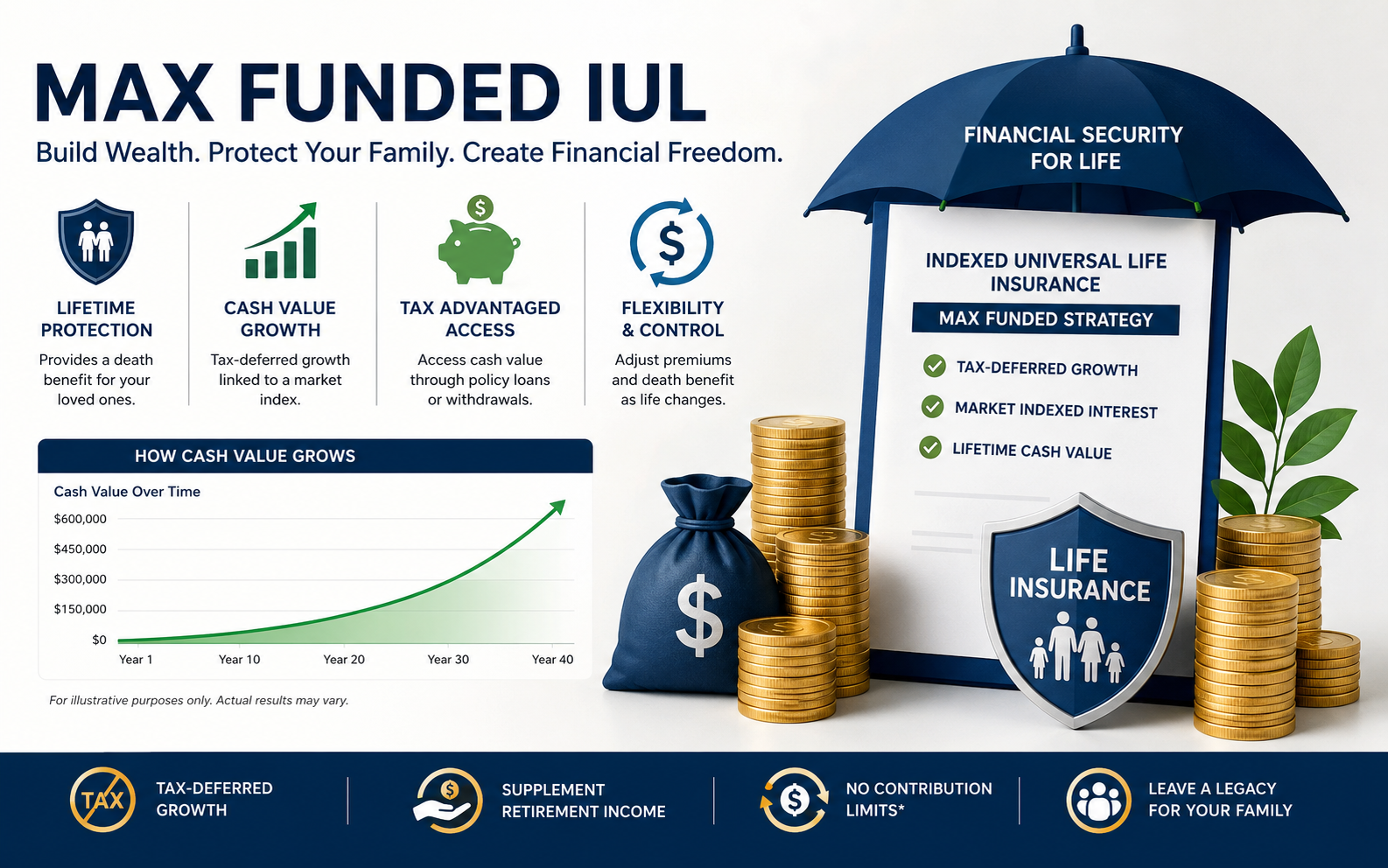
Cash value is one of the defining features of a max funded IUL. Every premium payment contributes toward building this internal account after policy expenses are deducted. The longer the policy remains active and adequately funded, the greater the opportunity for meaningful accumulation.
Interest is credited based on an external market index rather than direct stock ownership. If the chosen index performs well, the insurance company credits interest according to the policy’s terms. If the index declines, the policy’s floor generally protects against negative credited interest, although fees and insurance costs still apply.
Growth depends on numerous factors including premium levels, age, policy design, interest caps, participation rates, policy expenses, and the insurer’s performance. Because every policy differs, projections should always be reviewed carefully rather than relying on hypothetical illustrations alone.
Tax Benefits of a Max Funded IUL
Tax advantages are among the strongest reasons people consider a max funded IUL. The cash value generally grows on a tax-deferred basis, meaning taxes are not paid annually on interest credited within the policy.
When structured properly, policy loans may provide access to accumulated cash value without creating immediate taxable income. Many retirees use this feature to supplement retirement income while managing their overall tax situation. However, loans reduce the available death benefit and must be managed carefully to avoid policy lapse.
The death benefit is generally paid income tax-free to beneficiaries under current U.S. tax law. This feature allows families to receive financial protection while potentially avoiding income taxes on the insurance proceeds.
Max Funded IUL vs Traditional Retirement Accounts
A max funded IUL should not necessarily replace retirement accounts such as a 401(k) or IRA. Instead, many financial planners view it as a complementary strategy that provides additional flexibility.
Retirement accounts often offer employer matching contributions and potential tax deductions, making them valuable first options for many workers. However, these accounts also have contribution limits, required minimum distributions in some cases, and rules governing withdrawals.
A properly structured max funded IUL has no IRS contribution limits in the same sense as retirement accounts, although policy funding limits still apply. There are generally no required minimum distributions, and policyholders maintain greater flexibility regarding when and how they access accumulated cash value.
Advantages of Choosing a Max Funded IUL
One major advantage is permanent life insurance coverage that lasts throughout the insured’s lifetime as long as policy requirements are met. This provides financial security for loved ones while allowing the policy to serve additional financial planning purposes.
Another benefit is flexibility. Unlike some traditional financial products with rigid contribution requirements, many IUL policies allow premium adjustments within policy guidelines. This flexibility can help policyholders navigate changing financial circumstances over decades.
A third advantage is diversification. Since retirement planning often involves multiple income sources, adding a max funded IUL can reduce dependence on taxable retirement accounts or Social Security alone. Diversifying tax treatment may improve retirement planning flexibility.
Potential Risks and Limitations
No financial strategy is perfect, and a max funded IUL has several important limitations that should be understood before purchasing a policy. Insurance costs, administrative fees, and policy charges can affect long-term performance, particularly during the early years.
Interest crediting is also limited by caps and participation rates. Even if the market performs exceptionally well, policyholders may not receive the full market return because insurance companies establish maximum credited interest levels.
Policy loans require responsible management. Excessive borrowing or insufficient premium payments may cause the policy to lapse, potentially creating unexpected tax consequences. Regular policy reviews are essential to maintain long-term sustainability.
Who Should Consider a Max Funded IUL?
Individuals with stable income who have already established emergency savings and are consistently contributing toward retirement often find this strategy worth exploring. Those seeking additional tax diversification may especially appreciate the flexibility a properly designed IUL can provide.
Business owners frequently use max funded IUL policies as part of broader financial planning. The ability to build tax-advantaged cash value while maintaining life insurance protection can complement other investment and retirement strategies.
Families interested in creating a financial legacy also benefit from the permanent death benefit. Even if cash value is accessed during retirement, beneficiaries may still receive meaningful life insurance proceeds depending on the remaining policy value.
Common Misconceptions About Max Funded IUL
A common misconception is that an Indexed Universal Life policy directly invests money in the stock market. In reality, the insurance company credits interest based on an index rather than purchasing shares for the policyholder.
Another misunderstanding is that a max funded IUL guarantees exceptionally high returns every year. While the floor helps reduce downside risk, growth depends on market index performance, policy design, and insurance company crediting methods. Returns can vary significantly over time.
Some people also believe that policy loans are completely free. Although loans can provide tax advantages, they generally accrue interest and affect the policy’s long-term performance if not managed carefully. Understanding loan mechanics is essential before relying on them for retirement income.
Tips for Maximizing the Benefits of a Max Funded IUL
Working with an experienced insurance professional is one of the most important steps. Policy design has a significant impact on long-term performance, and a properly structured policy should align with your financial objectives rather than emphasizing only the largest possible death benefit.
Funding consistency also matters. Regular premium payments during the early years typically produce stronger long-term cash value growth than inconsistent contributions. Following the recommended funding schedule helps maximize accumulation potential.
Annual policy reviews should never be overlooked. Insurance costs, index performance, and financial goals change over time. Reviewing the policy regularly allows adjustments before small issues become significant problems.
Is a Max Funded IUL Worth It?
Whether a max funded IUL is worthwhile depends entirely on your personal financial goals, risk tolerance, income level, and retirement strategy. For some individuals, it provides an attractive combination of permanent life insurance, tax-deferred growth, flexible retirement income, and estate planning benefits.
Others may find traditional investments, retirement accounts, or simpler insurance products more suitable depending on their circumstances. The key is understanding that a max funded IUL is a long-term financial tool rather than a short-term investment.
Taking time to compare illustrations from highly rated insurance companies, understanding all policy charges, and consulting both financial and tax professionals can help ensure the strategy supports your overall financial objectives.
Conclusion
A max funded IUL is much more than a life insurance policy. When designed correctly, it becomes a long-term financial strategy focused on maximizing cash value accumulation while preserving permanent life insurance protection. Its combination of tax-deferred growth, flexible premium options, downside protection through indexed crediting, and potential tax-advantaged retirement income has made it increasingly popular among individuals seeking greater financial flexibility.
Like any sophisticated financial product, success depends on proper design, realistic expectations, and ongoing management. It should never be viewed as a replacement for every other investment or retirement account but rather as one component of a diversified financial plan. Understanding both the advantages and the limitations allows policyholders to make informed decisions instead of relying on marketing claims alone.
Ultimately, a well-structured max funded IUL can provide meaningful benefits for individuals who are committed to long-term financial planning. By combining disciplined funding, regular policy reviews, and professional guidance, many policyholders are able to build valuable cash reserves while protecting the financial future of their families.
One of the biggest reasons people choose a max funded IUL is the opportunity to build tax-advantaged wealth alongside permanent life insurance protection. Many investors appreciate having another retirement income source that does not rely entirely on traditional retirement accounts.
Another attractive feature is downside protection. Because indexed universal life policies generally include a floor, market downturns typically do not result in direct losses to the policy’s credited interest. While this also means gains are capped during strong market years, many conservative investors value the balance between growth potential and protection.
Flexibility also plays a significant role. Policyholders often have the ability to adjust premium payments, modify death benefits within policy rules, and access accumulated cash value if financial needs arise. This flexibility makes the strategy appealing for individuals with changing financial circumstances.


