

Introduction
Operations are the backbone of every successful organization. Whether it is a small local business, a growing startup, or a multinational corporation, operations determine how efficiently products are created, services are delivered, and customer expectations are met.
While marketing and sales often receive the most attention, it is the operations team that ensures everything works smoothly behind the scenes. Without effective operations, even the best business ideas can struggle to survive.
Operations involve planning, organizing, managing, and improving the processes that keep a business functioning every day. From purchasing raw materials to delivering finished products, every step falls under operations management. The goal is to maximize productivity while minimizing costs, delays, and waste.
Companies that focus on strong operational strategies often enjoy higher profits, better customer satisfaction, and stronger long-term growth.
As technology continues to evolve, operations have become more sophisticated than ever before. Businesses now rely on automation, artificial intelligence, cloud computing, and real-time data to streamline workflows and make smarter decisions. Understanding operations is no longer important only for managers—it is valuable for entrepreneurs, employees, and anyone interested in how successful organizations achieve consistent results.
What Are Operations?

Operations refer to the daily activities and processes that help an organization produce goods or deliver services. These activities include planning, sourcing materials, managing employees, maintaining equipment, controlling quality, and ensuring products or services reach customers on time. Every department contributes to operations in some way, making it a company-wide responsibility.
For manufacturing companies, operations focus heavily on production, inventory management, and quality control. In service-based businesses, operations involve scheduling, customer support, resource management, and delivering excellent experiences. Although the tasks differ, the objective remains the same: creating value for customers while using resources efficiently.
Modern operations are much more than simply completing routine tasks. Businesses constantly analyze their processes to identify inefficiencies and opportunities for improvement. Continuous optimization allows organizations to remain competitive, reduce costs, and adapt quickly to changing market demands.
Why Operations Matter in Every Business
Operations directly affect the profitability and reputation of any business. Efficient operations reduce unnecessary expenses, improve productivity, and ensure customers receive products or services when promised. Even companies with excellent marketing strategies can lose customers if their operations fail to deliver consistent quality.
Customer satisfaction is closely connected to operational performance. Fast delivery, reliable service, accurate orders, and high-quality products all depend on well-managed operations. Businesses that consistently exceed customer expectations often have strong operational systems working behind the scenes.
Operations also play an important role in supporting business growth. As companies expand, managing larger teams, increased production, and growing customer demand becomes more challenging.
Effective operational planning ensures businesses can scale successfully without sacrificing quality or efficiency.
Key Components of Operations Management
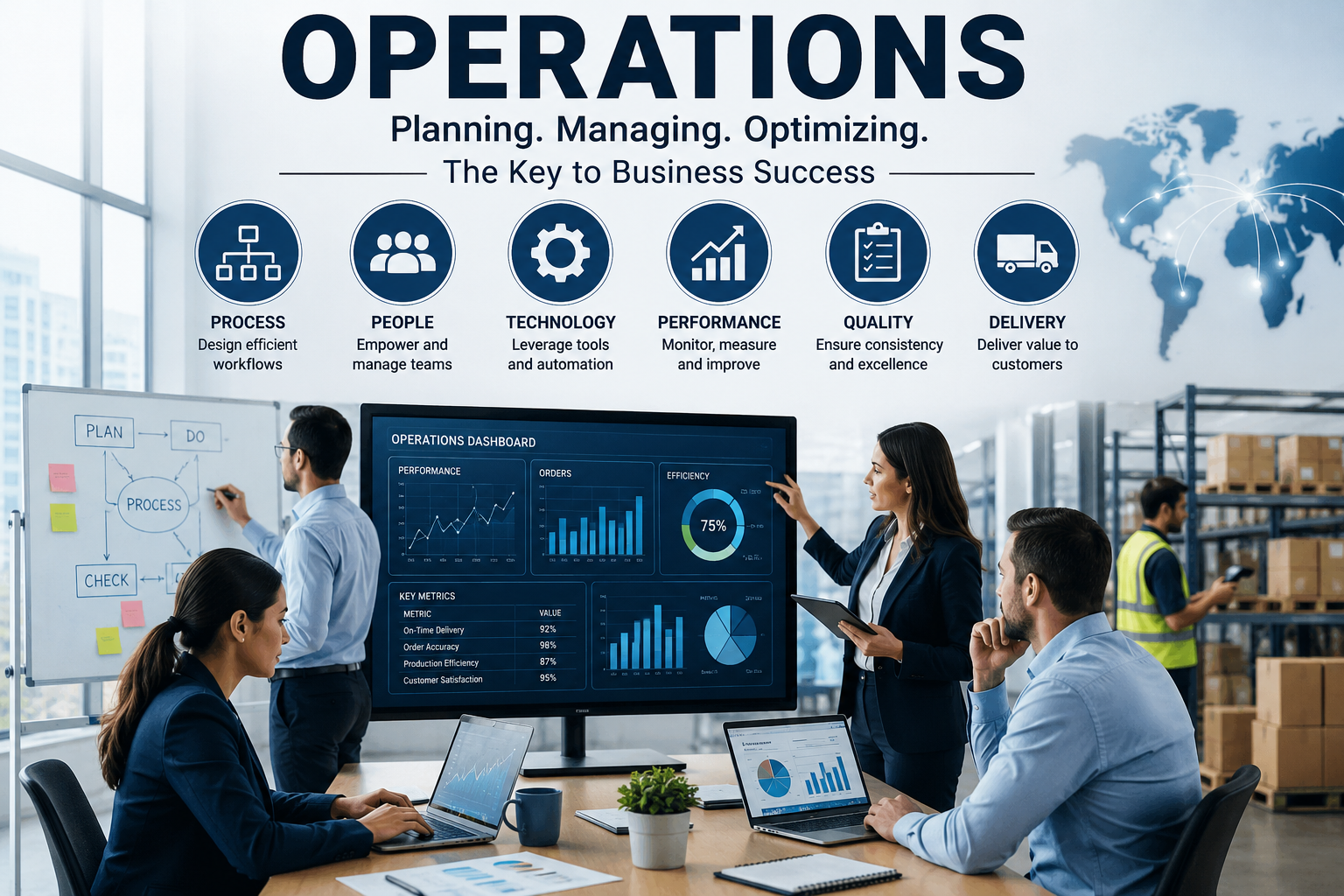
Operations management consists of several interconnected areas that work together to achieve organizational goals. One of the most important components is process planning.
This involves designing efficient workflows that reduce unnecessary steps while maximizing productivity.
Well-planned processes save time, reduce costs, and improve consistency.
Another essential component is resource management.
Businesses must carefully Operations allocate employees, equipment, technology, finances, and materials to ensure everything operates smoothly. Poor resource management often results in delays, increased costs, and reduced productivity.
Quality management is equally important. Companies establish quality standards, monitor performance, identify defects, and implement improvements to ensure customers consistently receive reliable products or services.
Maintaining high quality strengthens customer trust and builds long-term loyalty.
The Role of Technology in Modern Operations
Technology has transformed operations across nearly every industry. Businesses now use software solutions to automate repetitive tasks, monitor inventory, schedule employees, analyze data, and communicate across departments. These digital tools improve accuracy while reducing manual work.
Artificial intelligence and machine learning have introduced predictive capabilities into operations management. Businesses can forecast demand, optimize inventory levels, identify maintenance needs before equipment fails, and improve customer service through intelligent automation. These technologies help organizations make faster and Operations more informed decisions.
Cloud-based systems have also improved collaboration by allowing employees to access operational data from anywhere. Remote teams can communicate effectively, share updates instantly, and manage projects in real time.
This flexibility has become especially valuable as hybrid and remote work environments continue to grow.
Common Challenges in Operations Management
Managing operations is not without its difficulties. One of the biggest challenges is balancing efficiency with quality. Businesses often aim to reduce costs, but cutting expenses too aggressively can negatively impact product quality or customer satisfaction. Successful organizations find the right balance between cost control and maintaining high standards.
Supply chain disruptions present another significant challenge.
Delays in receiving raw materials, transportation issues, or supplier shortages can interrupt production schedules and affect customer deliveries. Companies reduce these risks by diversifying suppliers, improving inventory planning, and developing contingency Operations plans.
Workforce management also requires careful attention.
Hiring skilled employees, providing proper training, maintaining motivation, and ensuring effective communication all contribute to operational success. Businesses that invest in employee development typically experience stronger productivity and lower turnover rates.
Best Practices for Improving Operations
Continuous improvement is one of the most effective strategies for strengthening operation. Rather than accepting existing processes as permanent, successful businesses regularly review performance data and identify opportunities for improvement.
Small changes implemented consistently often produce significant long-term results.
Clear communication between departments is another essential practice.
Sales, marketing, finance, production, and customer service must work together toward common goals. Strong communication prevents misunderstandings, reduces delays, and improves decision-making throughout the organization.
Data-driven decision-making has become increasingly important in operation management. Businesses collect performance metrics, customer feedback, production statistics, and financial information to evaluate efficiency.
Using accurate data allows leaders to identify trends, solve problems quickly, and make informed strategic decisions.
Operations Across Different Industries
Operation vary depending on the industry, but the fundamental principles remain similar. In manufacturing, operation focus on production scheduling, equipment maintenance, inventory management, and quality assurance.
Efficiency directly influences production costs and overall profitability.
Healthcare organizations depend on operation to coordinate patient care, manage medical supplies, schedule staff, and maintain compliance with healthcare regulations.
Efficient operation help hospitals improve patient outcomes while controlling operational expenses.
Retail businesses rely on operation for inventory management, order fulfillment, supplier coordination, pricing strategies, and customer service. E-commerce companies, in particular, depend heavily on fast logistics and accurate order processing to remain competitive in today’s marketplace.
The Future of Operations
The future of operation will continue to be shaped by technological innovation. Automation, robotics, artificial intelligence, and predictive analytics will become even more integrated into daily business processes.
Organizations that embrace these technologies will gain competitive advantages through improved efficiency and reduced operational costs.
Sustainability is also becoming a major focus within operatio management.
Businesses are adopting environmentally responsible practices by reducing waste, improving energy efficiency, minimizing emissions, and using recyclable materials. Sustainable operation not only benefit the environment but also improve brand reputation among increasingly eco-conscious consumers.
Another emerging trend is greater operational flexibility.
Companies are building agile systems capable of responding quickly to market changes, economic uncertainty, and shifting customer expectations.
Organizations that remain adaptable will be better positioned for long-term success in an increasingly competitive global economy.
Skills Needed for Successful Operations Management
Professionals working in operation require a diverse combination of technical knowledge and leadership skills. Problem-solving abilities are essential because operational challenges often require quick and practical solutions. Strong analytical thinking helps managers evaluate data, identify trends, and improve business performance.
Communication skills are equally valuable.
Operation managers coordinate with employees, suppliers, customers, executives, and external partners. Clear communication reduces confusion and ensures everyone works toward shared objectives.
Leadership and adaptability complete the skill set. Effective leaders motivate teams, encourage innovation, and manage change successfully.
As business environments continue evolving rapidly, adaptable professionals can respond confidently to new technologies, changing customer expectations, and unexpected operational challenges.
Conclusion
Operation are at the heart of every successful business. They influence productivity, customer satisfaction, profitability, and long-term sustainability.
While operation may not always be visible to customers, they determine whether a business consistently delivers on its promises. Strong operational management creates efficient workflows, supports growth, and provides organizations with a competitive advantage.
As technology advances and industries continue evolving, operation will become even more strategic. Businesses that invest in process improvement, employee development, technological innovation, and customer-focused operation will be better equipped to thrive in the future. Regardless of company size or industry, mastering operation remains one of the most valuable investments any organization can make.
How Strong Operations Create Long-Term Business Success
Strong operations are one of the biggest reasons why successful businesses continue to grow year after year. When every process is planned carefully, employees know their responsibilities, resources are used efficiently, and customers receive consistent service.
This creates a positive experience that encourages repeat business and strengthens the company’s reputation.
Businesses with well-organized operations are also better prepared to handle unexpected challenges such as supply chain disruptions, changing customer demands, or market competition.
Improving operations is an ongoing process rather than a one-time task.
Companies regularly review their workflows, analyze performance data, and gather customer feedback to identify areas for improvement. Even small adjustments, such as reducing production time, improving communication between departments, or adopting new technology, can lead to significant increases in productivity and profitability over time. Continuous improvement helps businesses remain competitive in an ever-changing marketplace.
Ultimately, operations connect every part of an organization. From procurement and production to customer service and delivery, every department depends on efficient operational processes. Businesses that invest in better planning, employee training, process optimization, and technology create a strong foundation for sustainable growth. Regardless of industry or company size, effective operations remain one of the most important drivers of long-term success, helping organizations achieve higher efficiency, better customer satisfaction, and stronger financial performance.


