

IntroductionComputational Thinking
Computational thinkin has become one of the most valuable skills in today’s technology-driven world. While many people associate it with computer programming, the truth is that computational thinkin goes far beyond writing code. It is a structured way of solving problems by breaking them into smaller, manageable parts and finding efficient solutions that can be repeated or automated. This approach is useful in education, business, science, healthcare, engineering, and even everyday life.
As technology continues to shape every aspect of society, individuals who understand computational thinkin are often better equipped to tackle complex challenges. Whether you’re organizing your daily schedule, planning a business project, or developing software, this mindset helps you think logically and make smarter decisions.
The best part is that computational thinkin isn’t limited to computer scientists. Students, teachers, entrepreneurs, designers, and professionals from every industry can benefit from learning and applying these principles. It encourages creativity while improving analytical and critical thinking skills, making it one of the most practical abilities to develop in the modern world.
What Is Computational Thinking?
Computational thinking is a problem-solving process that involves understanding a problem, organizing information, identifying patterns, creating step-by-step solutions, and evaluating results. It focuses on finding efficient methods that can often be performed by humans or computers.
Instead of jumping directly into solving a complicated issue, computational thinkinen courages people to analyze the situation carefully. By dividing a large problem into smaller sections, it becomes much easier to understand what needs to be done. This structured approach reduces confusion and improves the quality of the final solution.
Many educational systems now include computational thinkin as part of their curriculum because it teaches students how to think rather than simply memorize information. It develops logical reasoning and encourages learners to explore multiple solutions before selecting the most effective one.
The Four Core Components of Computational Thinking
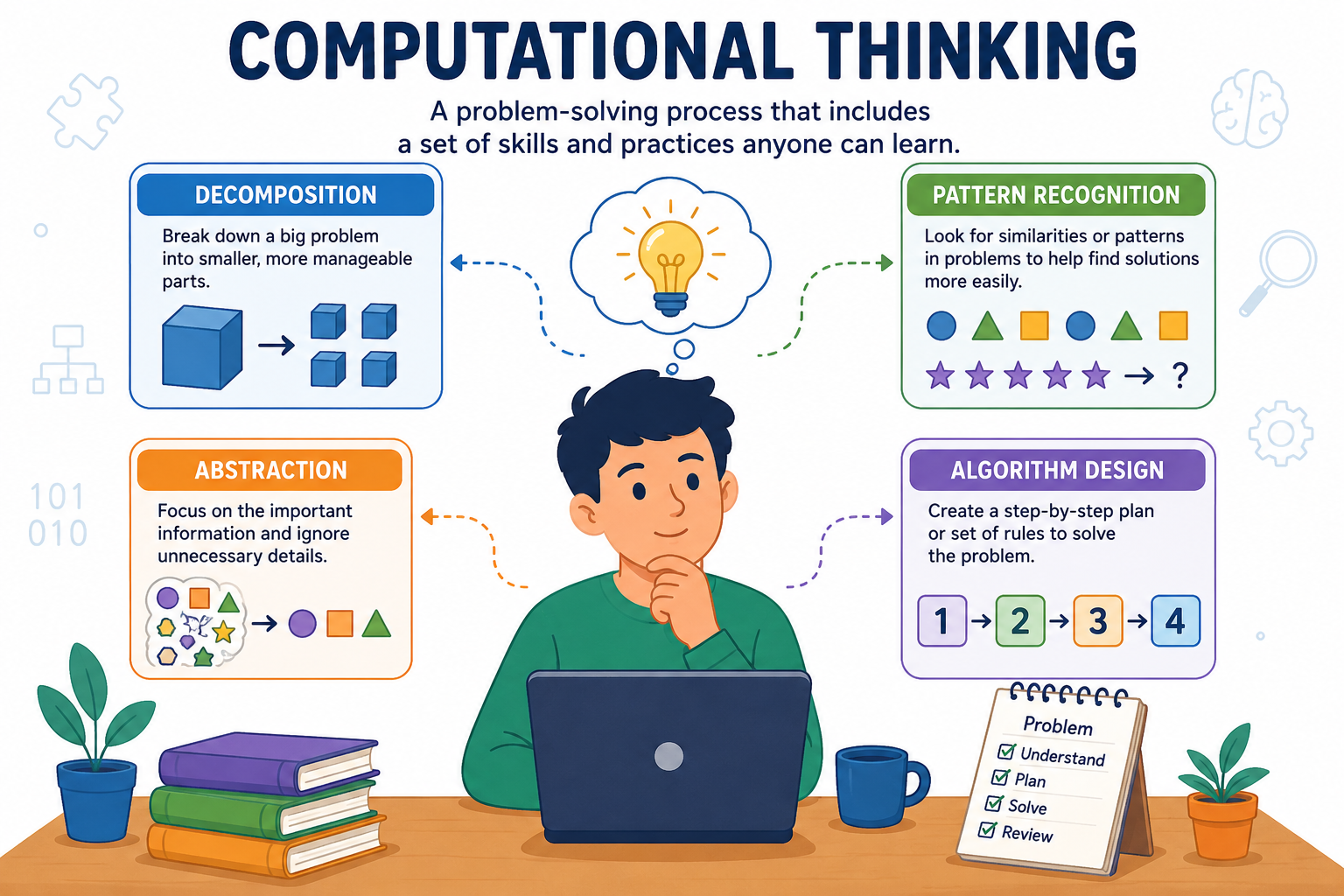
One of the most important elements of computational thinkin is decomposition. This means breaking a large problem into smaller, manageable tasks. For example, planning a vacation involves booking transportation, finding accommodation, creating an itinerary, and managing a budget. Handling each task individually makes the entire project easier to complete.
Pattern recognition is another essential component. It involves identifying similarities or recurring trends within problems. Recognizing patterns helps people predict outcomes and reuse successful solutions instead of starting from scratch every time. Businesses frequently use pattern recognition to understand customer behavior and improve services.
Abstraction is the ability to focus only on the important information while ignoring unnecessary details. This simplifies complicated situations and allows people to concentrate on what truly matters. The final component is algorithm design, where clear, step-by-step instructions are created to solve the problem efficiently. Algorithms are not limited to computers—they are present in everyday routines such as following a recipe or assembling furniture.
Why Computational Thinking Matters Today
Modern workplaces increasingly value employees who can solve problems creatively and logically. Computaional thinking equips individuals with these abilities, allowing them to analyze situations systematically and make informed decisions under pressure.
Technology is integrated into nearly every industry, from healthcare and finance to manufacturing and education. Professionals who understand computational thinking can adapt more quickly to technological changes because they know how to approach unfamiliar challenges using structured methods rather than relying on trial and error.
Beyond professional life, computatonal thinking also improves everyday decision-making. Whether managing personal finances, organizing household responsibilities, or planning long-term goals, applying logical processes often leads to better results and fewer mistakes.
Computational Thinking in Education
Schools around the world are recognizing that computatioal thinking is a foundational skill for future careers. Instead of teaching students only how to use technology, educators now emphasize understanding how technology works and how problems can be solved systematically.
Introducing computatioal thinking at an early age helps children develop confidence in mathematics, science, and logical reasoning. Activities such as puzzles, robotics, coding games, and collaborative projects naturally strengthen these abilities while making learning enjoyable.
Teachers also benefit from computational thinking because it helps them design more engaging lessons and encourages students to think independently. Rather than memorizing answers, students learn how to investigate problems, evaluate evidence, and develop their own solutions.
Real-Life Examples of Computational Thinking
Computational thinking appears in everyday activities more often than many people realize. Cooking a meal requires following an ordered sequence of steps while adjusting ingredients based on available resources. This process closely resembles algorithm design.
Shopping also involves computational thinking. Consumers compare prices, identify purchasing patterns, prioritize needs, and create budgets before making decisions. Breaking financial planning into smaller tasks helps shoppers spend more wisely.
Businesses rely heavily on computational thinking when managing operation. Companies analyze customer data, identify market trends, optimize supply chains, and automate repetitive tasks. These structured approaches improve efficiency while reducing operational costs.
Computational Thinking and Programming
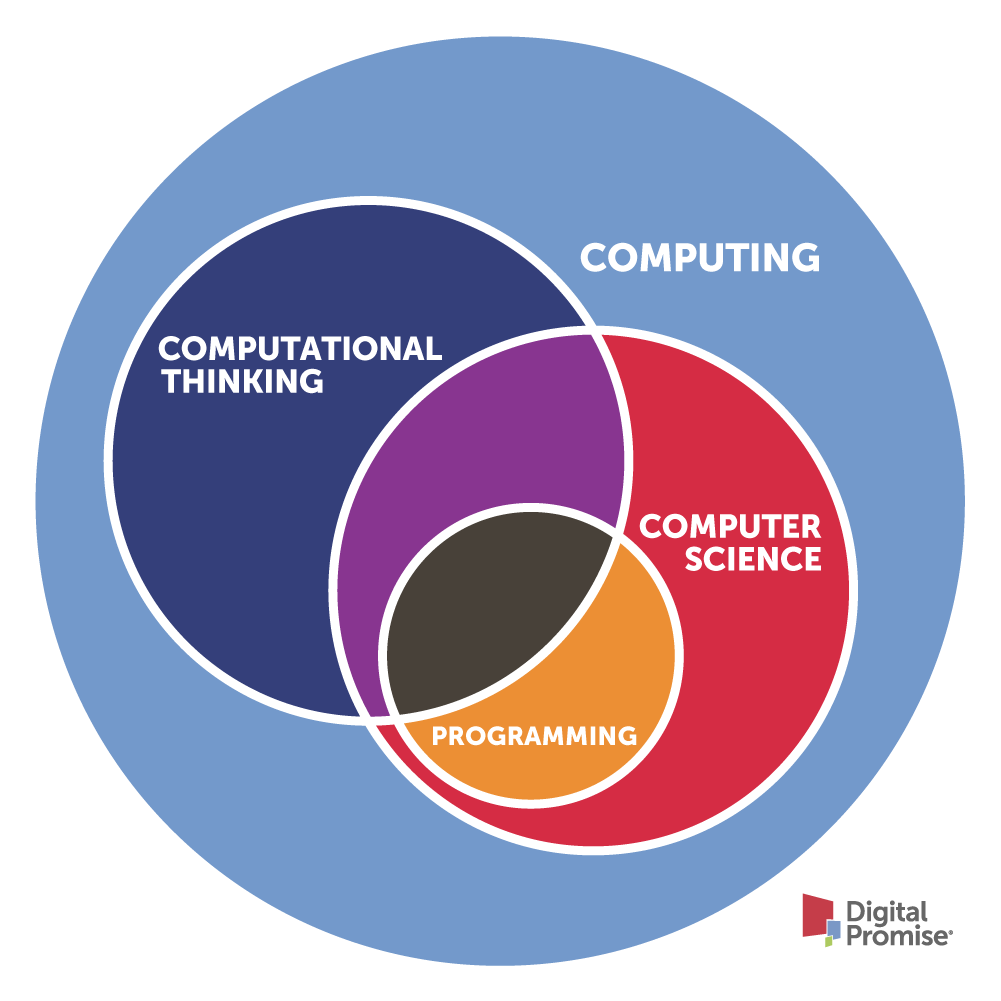
Although computational thinking and programming are closely connected, they are not the same thing. Computational thinking focuses on the process of solving problems, while programming is the act of translating those solutions into code that computers can execute.
Someone can possess excellent computational thinking skills without knowing any programming language. For example, project managers, architects, doctors, and engineers regularly apply computational thinking despite rarely writing software themselves.
Learning programming becomes much easier when someone already understands computational thinking. Instead of struggling with syntax alone, learners understand the reasoning behind each instruction and develop stronger problem-solving habits that transfer across different programming languages.
Benefits of Developing Computational Thinking Skills
One of the biggest benefits of computational thinking is improved problem-solving ability. Individuals become more comfortable analyzing difficult situations and creating organized plans instead of feeling overwhelmed by complexity.
Another major advantage is increased creativity. While computational thinking is often associated with logic, it actually encourages innovative solutions by allowing people to explore multiple possibilities before selecting the best approach. Creative thinking and logical thinking work together rather than competing with one another.
Computational thinking also enhances communication and teamwork. When problems are broken into smaller components, team members can divide responsibilities more effectively, collaborate efficiently, and understand each other’s contributions more clearly.
How to Improve Computational Thinking
Developing computational thinking does not require expensive software or advanced technical knowledge. Solving puzzles, playing strategy games, learning basic programming concepts, and participating in logic challenges are excellent ways to strengthen these skills over time.
Practicing decomposition in daily life can also make a significant difference. Whenever faced with a complicated task, try dividing it into smaller steps before beginning. This simple habit reduces stress and makes even difficult projects feel more manageable.
Reading case studies, analyzing real-world problems, and reflecting on different solution methods further improve computational thinking. The more frequently people practice structured reasoning, the more natural it becomes in both personal and professional situations.
Common Misconceptions About Computational Thinking
Many people mistakenly believe computational thinking is only useful for software developers. In reality, professionals across countless industries use these principles to solve practical problems every day. Healthcare workers organize patient care, marketers analyze customer trends, and engineers optimize production systems using computational thinking.
Another misconception is that computational thinking requires advanced mathematics. While mathematical knowledge can certainly help, the core focus is logical reasoning, organization, and structured problem-solving rather than complex calculations.
Some also assume computational thinking removes creativity from the problem-solving process. The opposite is actually true. By organizing information effectively, individuals gain more freedom to experiment with creative ideas while maintaining logical consistency throughout their work.
The Future of Computational Thinking
As artificial intelligence, automation, robotics, and data science continue to evolve, computational thinking will become even more valuable. Organizations increasingly seek professionals who can understand complex systems and create efficient solutions rather than simply operate technology.
Future careers will require individuals who can adapt quickly to changing technologies and continuously learn new skills. Computational thinking provides a strong foundation for lifelong learning because it emphasizes flexible reasoning instead of memorizing fixed procedures.
Educational institutions and employers alike are investing in computational thinking because it prepares people for challenges that may not even exist today. Developing this mindset ensures individuals remain competitive in an increasingly digital and innovation-driven economy.
Conclusion
Computational thinking is far more than a technical concept—it is a practical way of approaching problems with logic, creativity, and efficiency. By breaking challenges into smaller parts, recognizing patterns, simplifying complex information, and designing step-by-step solutions, individuals can solve problems more effectively in every aspect of life.
Whether you are a student preparing for future opportunities, a professional seeking career growth, or simply someone looking to improve everyday decision-making, computational thinking is a skill worth developing. It encourages critical thinking, supports innovation, and builds confidence when facing unfamiliar situations.
In an increasingly digital world, the ability to think computationally is becoming just as important as reading, writing, and mathematics. By practicing these principles consistently, anyone can become a more effective problem solver and better prepared for the challenges and opportunities of the future.
Computational Thinking and Future Career Success
As the world becomes increasingly dependent on technology, computational thinking is emerging as one of the most valuable skills for future career success. Employers are no longer looking only for technical expertise; they also want individuals who can analyze complex situations, think critically, and develop practical solutions. Computationa
l thinking provides exactly these abilities, making professionals more adaptable in fast-changing work environments.
This skill is useful across a wide range of industries, not just information technology. Healthcare professionals use computational thinking to improve patient care and manage medical data efficiently. Business leaders rely on it to analyze market trends, optimize operations, and make informed decisions. Engineers, scientists, marketers, teachers, and even artists apply com
putational thinking to solve problems creatively and improve productivity in their respective fields.
Learning computatio
nal thinking also prepares individuals for emerging technologies such as artificial intelligence, machine learning, robotics, and data science. As these technologies continue to transform industries, people who can think logically, identify patterns, and design efficient solutions will have a significant advantage. By developing computational thinking today, students and professionals build a strong foundation for lifelong learning, career growth, and success in an increasingly digital world.


