

Boolean Searc
Boolean Search Searching online has become part of our everyday lives. Whether you’re looking for academic research, business contacts, job candidates, or simply trying to find reliable information, the quality of your search determines the quality of your results. While most people type a few words into a search engine and hope for the best, professionals often rely on a much more effective technique known as Boolean search.
Boolean search is a powerful search method that uses logical operators to narrow, expand, or refine search results. It helps users eliminate irrelevant information and quickly locate exactly what they need. From recruiters and researchers to digital marketers and students, millions of professionals use Boolean search every day to improve efficiency and accuracy.
In this guide, you’ll learn everything you need to know about Boolean search, including how it works, the most important operators, practical examples, advanced techniques, common mistakes, and tips for becoming a better searcher.
What Is Boolean Search?
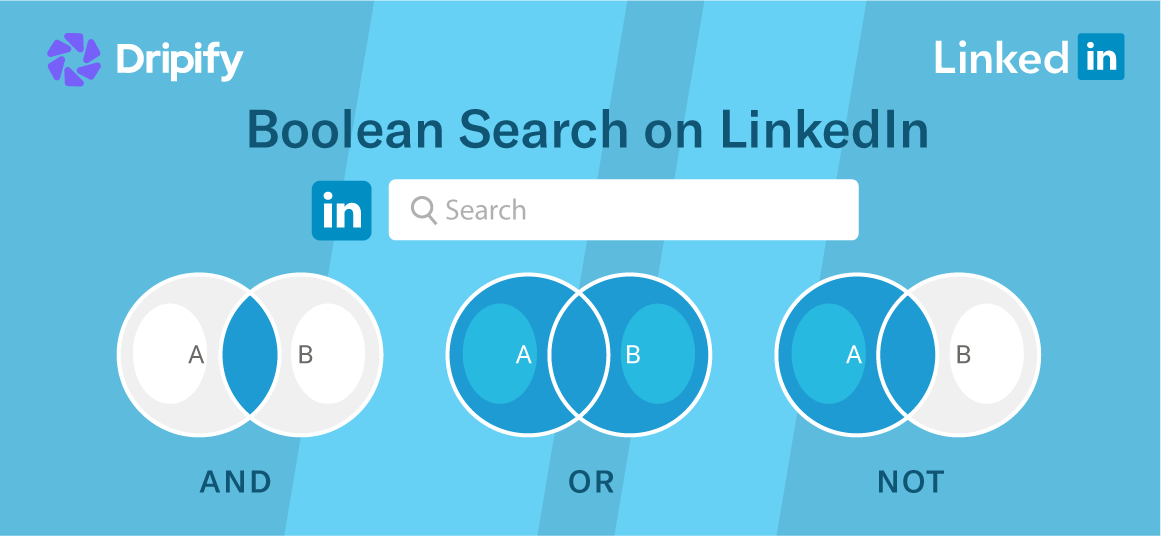
Boolean search is a search technique based on Boolean logic, a mathematical system developed by English mathematician George Boole in the 19th century. The concept uses logical operators such as AND, OR, and NOT to define relationships between keywords. These operators tell a search engine or database exactly how different search terms should be combined.
Instead of relying on simple keyword matching, Boolean search gives users greater control over what appears in their search results. For example, someone searching for information about “Apple” may want results related to the technology company instead of the fruit. Boolean operators make it easier to specify that intention.
Today, Boolean search is supported by many search engines, research databases, recruitment platforms, library catalogs, online marketplaces, and enterprise search systems. Although the exact syntax may vary slightly across platforms, the underlying principles remain largely the same.
Why Boolean Search Is So Important
The internet contains billions of pages, making it increasingly difficult to locate precise information through basic searches alone. Boolean search significantly improves search accuracy by filtering unnecessary content before it even appears.
Professionals working with large datasets particularly benefit from Boolean search. Recruiters use it to identify candidates with specific qualifications. Researchers use it to find relevant studies. Journalists use it to verify facts quickly, while SEO specialists use Boolean operators to discover content opportunities and analyze competitors.
Using Boolean search also saves valuable time. Instead of opening dozens of irrelevant pages, users can build targeted search queries that deliver highly relevant results almost immediately. This improves productivity while reducing frustration.
Understanding the Main Boolean Operators
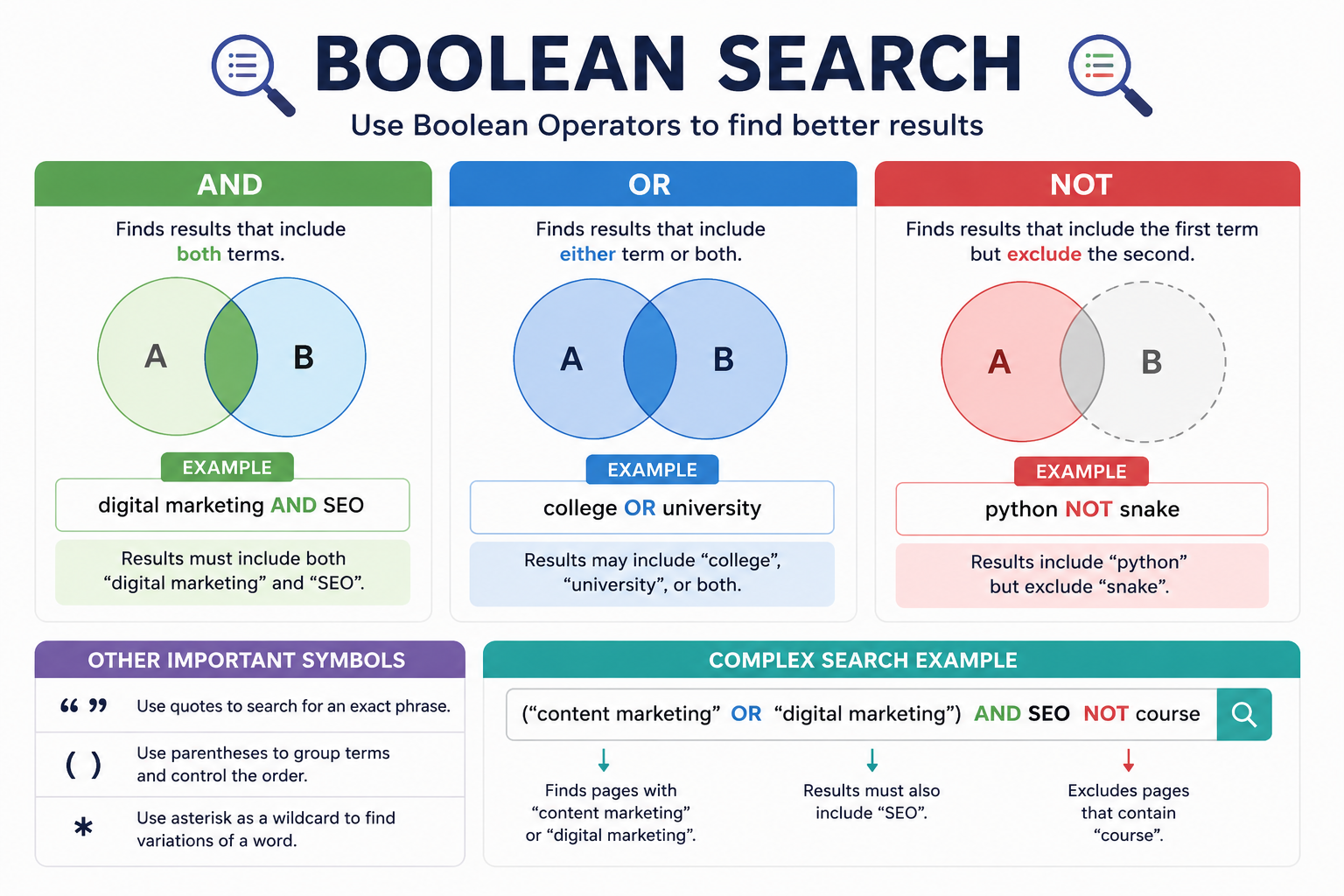
The foundation of Boolean search consists of three primary operators: AND, OR, and NOT. Each operator performs a unique function that changes how search results are displayed.
The AND operator requires every specified keyword to appear within the results. This narrows the search by focusing only on content containing all selected terms. For example:
SEO AND content marketing
This search returns pages that discuss both SEO and content marketing rather than either topic individually.
The OR operator broadens the search by allowing either keyword to appear. This is especially useful when different terms describe the same concept. For example:
college OR university
The search returns results containing either “college,” “university,” or both.
The NOT operator excludes unwanted keywords from the results. It removes pages containing specific terms that may create confusion or irrelevant matches. For example:
python NOT snake
This search prioritizes programming-related content while excluding information about reptiles.
Using Quotation Marks for Exact Matches
Quotation marks are among the most valuable search tools available. They instruct search engines to look for an exact phrase instead of treating each word separately.
Suppose you’re searching for the phrase:
“content marketing strategy”
Without quotation marks, the search engine may return pages containing those words in any order. By placing the phrase inside quotes, only pages containing that exact wording receive priority.
This technique is particularly useful when searching for famous quotes, article titles, company names, product names, research papers, or specific statements.
Quotation marks can dramatically improve search precision, especially when working with long phrases or specialized terminology.
Parentheses and Complex Boolean Searches
As search queries become more advanced, parentheses help organize multiple conditions into logical groups. They function similarly to parentheses in mathematics by controlling the order of operations.
Consider this search:
(SEO OR “search engine optimization”) AND marketing
This query retrieves pages discussing marketing alongside either “SEO” or “search engine optimization.”
Without parentheses, the search engine may interpret the query differently, producing inconsistent results. Proper grouping ensures the intended logic is followed.
Advanced researchers often create highly sophisticated Boolean strings using multiple layers of parentheses to search enormous databases efficiently.
Wildcards and Truncation
Many databases support wildcard characters and truncation symbols to broaden searches without listing every possible variation.
For example:
market*
This may return:
market
markets
marketing
marketer
marketplace
Similarly, a wildcard can replace unknown letters in words.
Example:
wom?n
This may match:
woman
women
The exact symbols vary depending on the search platform, so it’s always worth reviewing the platform’s search documentation.
Boolean Search in Search Engines
Modern search engines support several Boolean features, although some simplify or automatically interpret operators.
Using quotation marks remains one of the most reliable methods for improving search quality. The minus sign often functions like the NOT operator.
Example:
digital marketing -advertising
This excludes pages heavily focused on advertising.
You can also combine operators.
Example:
“email marketing” AND automation
Although search engines have become more intelligent through AI and natural language processing, Boolean search still provides valuable precision for professional research.
Boolean Search for Recruitment
Recruiters are among the heaviest users of Boolean search. Hiring platforms often contain millions of candidate profiles, making manual searches impractical.
A recruiter searching for software developers might use:
(Java OR Python OR C++) AND Developer NOT Intern
This query identifies experienced developers while excluding internship candidates.
Recruiters frequently combine Boolean operators with location filters, experience levels, certifications, educational qualifications, and job titles to identify ideal candidates within seconds.
Mastering Boolean search can significantly improve recruitment efficiency and candidate quality.
Boolean Search for Academic Research
Students, professors, and researchers depend heavily on Boolean search when using academic databases.
Suppose a researcher wants studies discussing climate change and renewable energy while excluding fossil fuels.
A search might look like:
(“climate change”) AND (“renewable energy”) NOT coal
This eliminates many unrelated studies and allows researchers to focus on relevant scientific literature.
Most scholarly databases also allow filters for publication year, peer-reviewed articles, language, author names, and document types, making Boolean search even more effective.
Boolean Search in SEO
SEO professionals frequently use Boolean search for keyword research, content planning, and competitor analysis.
For example, an SEO specialist looking for guest posting opportunities might search:
“write for us” AND technology
Or:
intitle:”guest post” AND SEO
These searches reveal websites actively accepting guest contributions.
Boolean search also helps identify content gaps, discover industry discussions, analyze competitors’ content, and uncover niche-specific resources.
For digital marketers, Boolean search remains an essential research skill.
Common Boolean Search Examples
Understanding real-world examples makes Boolean search much easier to apply.
Example 1:
coffee AND organic
Only results containing both terms appear.
Example 2:
doctor OR physician
Results include either keyword.
Example 3:
apple NOT fruit
Technology-related pages receive priority.
Example 4:
“machine learning”
Returns the exact phrase.
Example 5:
(teacher OR educator) AND online
Finds online education-related content using either teaching term.
Practicing with different combinations gradually builds confidence and improves search efficiency.
Advantages of Boolean Search
One of the biggest advantages of Boolean search is accuracy. Instead of sorting through thousands of irrelevant pages, users receive targeted results aligned with their goals.
Boolean search also increases productivity. Researchers, recruiters, and marketers spend less time filtering information manually because much of the filtering happens automatically during the search process.
Another major benefit is flexibility. Users can build simple searches with one operator or create highly sophisticated queries involving multiple conditions, synonyms, exclusions, exact phrases, and grouped expressions.
Finally, Boolean search improves decision-making because it increases the likelihood of finding high-quality, relevant information.
Common Mistakes to Avoid
Many beginners misuse Boolean operators by combining too many keywords. Extremely restrictive searches may eliminate valuable results entirely.
Another common mistake is forgetting quotation marks when searching for exact phrases. Without them, search engines often interpret each word separately, leading to broader results than intended.
Improper use of parentheses can also produce unexpected outcomes. Complex queries should always be grouped logically to preserve the intended relationships between keywords.
Finally, users should avoid assuming every platform supports identical Boolean syntax. Search engines, databases, recruitment tools, and library catalogs may implement operators differently.
Tips for Writing Better Boolean Searches
Start with a simple query before adding additional operators. This makes it easier to understand how each modification affects the results.
Think about synonyms. People often describe the same concept using different words. Including alternatives with the OR operator helps capture a wider range of relevant information.
Use quotation marks whenever searching for names, titles, product names, or exact phrases. This small adjustment often produces dramatically better results.
Test different versions of your search. Sometimes replacing one keyword with another produces significantly better results. Boolean search is an iterative process that improves through experimentation.
Review the documentation for the specific platform you’re using. Understanding supported operators allows you to maximize search performance.
Boolean Search vs Natural Language Search
Modern search engines increasingly support natural language searches powered by artificial intelligence. Users can now type complete questions instead of keyword combinations.
Natural language search is excellent for general information, quick answers, and conversational queries. However, it often sacrifices precision in exchange for convenience.
Boolean search remains superior whenever accuracy matters. Professional research, legal databases, recruitment systems, academic libraries, and technical repositories still rely heavily on Boolean logic because users need complete control over search conditions.
Rather than replacing Boolean search, AI-powered search complements it. Knowing when to use each approach gives users the best of both worlds.
The Future of Boolean Search
Artificial intelligence continues to transform search technology, making search engines more capable of understanding context, intent, and conversational language. Despite these advancements, Boolean search remains highly relevant because logical operators provide a level of precision that AI alone cannot always guarantee.
Many enterprise systems continue integrating Boolean logic with machine learning, creating hybrid search experiences that combine human-defined logic with AI-powered relevance ranking. This approach delivers highly accurate results while maintaining flexibility.
As information continues growing at an unprecedented rate, professionals who understand Boolean search will remain better equipped to locate reliable information quickly and efficiently. The skill is likely to remain valuable across industries for many years.
Final Thoughts
Boolean search is much more than a collection of search operators. It is a practical problem-solving technique that allows users to search smarter instead of harder. By learning how to combine keywords using AND, OR, NOT, quotation marks, parentheses, and other advanced techniques, anyone can dramatically improve the quality of their search results.
Whether you’re conducting academic research, recruiting talented professionals, planning an SEO strategy, analyzing competitors, or simply looking for trustworthy information online, Boolean search provides the control and precision needed to find exactly what you’re looking for. Like any valuable skill, it becomes more powerful with regular practice. The more you experiment with different search combinations, the more naturally Boolean logic will become part of your everyday research process, helping you work faster, discover better information, and make more informed decisions.


